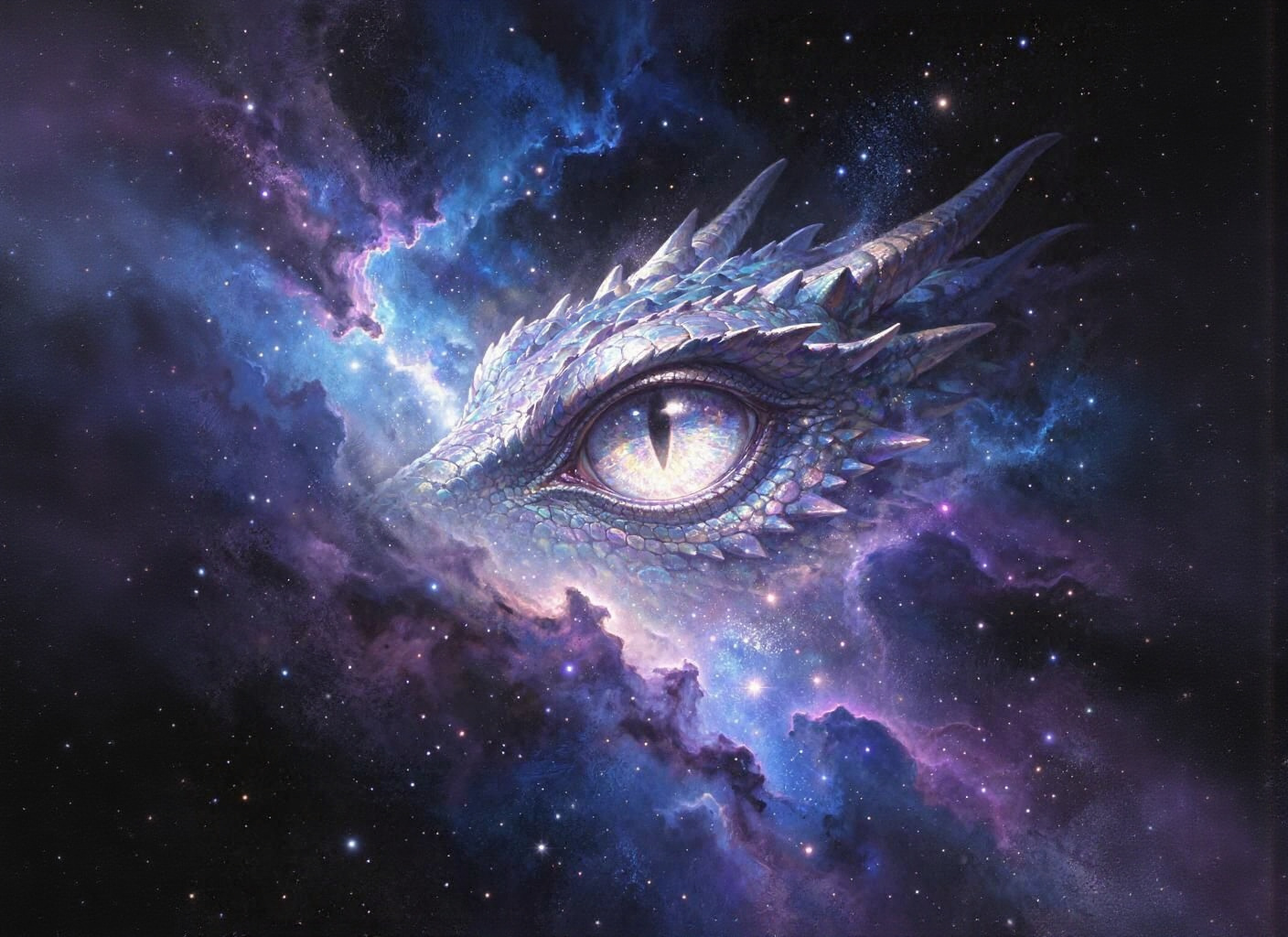
Pip: Annie Dieu-Le-Ver has a message for anyone who stumbled onto her blog: there are no coincidences, and there may be a dragon in your wardrobe.
Mara: This episode covers territory from several recent posts — serpent mythology, Gnostic paths, the mechanics of sacred lovemaking as a route to immortality, and what happens to civilizations when their leaders skip the initiation entirely.
Pip: Let’s start with the dragons themselves, and why the path to enlightenment apparently requires one.
Dragon Guides and the Gnostic Path to Gnosis
Mara: Her central claim in her writings is that dragon spirit guides are not metaphors — they are the essential vehicle for anyone serious about escaping the cycle of reincarnation. The first post frames it plainly: “To go from Earth to Heaven, we need to follow The Way, and mount the vehicle that carries us to the flaming-wheeled Chariot or Merkaba rocket ship in our DNA…and that vehicle is the dragon.”
Pip: So the Ten Commandments are not enough. Noted. What this means in practice is that no human teacher, workshop, or retreat can substitute — the transmission comes directly from the serpents, or it does not come at all.
Mara: The Gnostic angle sharpens that point considerably. The post on the hidden path of dragon guidance traces the Ophites — early Christians who revered the serpent as a wise teacher — and their writings, suppressed by the fourth century and only recovered at Nag Hammadi in 1945. The serpent in Eden, reframed: not a demon but a bestower of gnosis, a guide for burrowing out of this dimension.
Pip: The post on serpent symbolism in myth goes further back, citing anthropologist Michael Harner’s ayahuasca vision, in which giant reptilian creatures explained that they seeded life on Earth and have been hiding inside every living form ever since — a claim that lands surprisingly close to Francis Crick’s panspermia hypothesis.
Mara: And the post on how dragon guidance is essential to immortality gives the personal account: decades of ashrams and nunneries, and it still took until the author’s seventieth year for the dragons to arrive and begin filling the gaps — gaps caused, as the post puts it, by a mind like the destroyed Library of Alexandria, with astronomy shelved far from astrology and physics in a separate room from alchemy.
Pip: The post asking whether dragons are real offers the clearest description of what living with one actually involves — less fire-breathing monster, more thorough auditor who insists on going through every cupboard, including the one under the stairs you have been meaning to clear out for years.
Mara: The upshot is that the process clears the etheric field of unresolved business, so that at death there is no unfinished karma compelling a return. That is the practical mechanism behind the immortality claim.
Pip: Which leads directly to the question of how sacred lovemaking fits into all of this.
Sacred Lovemaking as the Path to Immortality
Mara: The book announcement post makes the stakes explicit with a quote from nineteenth-century philosopher Paul Carus: “Death is the problem of life, but Love is its solution.” The practice described is not Tantra as commonly understood — it is specifically shaped for women, drawing on Taoist and Tibetan Buddhist frameworks largely absent from mainstream sacred-sex literature.
Pip: The companion post on how sacred lovemaking leads to enlightenment in women is where the mechanics get granular — the Great Cycle of Return, Tummo fire rising through the central channel to meet the descending Bindu droplet, spinning the Wheel of Light at the heart chakra. The practical note that this also saves significantly on heating bills is, apparently, not a joke.
Mara: The reason this matters is that the book positions itself as a companion for women already walking this path alone, without the support structures that once existed — the priestess traditions, the contemplative orders whose purpose was precisely this kind of work before institutional religion redirected it.
Pip: And that lost institutional support is exactly where the next segment lands.
Initiation, Sovereignty, and the Cost of Skipping Both
Mara: The post on sacred initiations and the fall of empires argues that the decline of civilizations follows a consistent pattern: leaders who were never initiated into the Mysteries by someone trained in sacred sex magic lack the wisdom to rule. The post states it directly: “When a king or president has not been initiated into the Mysteries of the land by a cuen, a female trained in the arts of sacred sex magic, they do not have the wisdom to rule over it.”
Pip: What this means in practice is that the spiritual vacancy at the top does not stay empty — it fills with what the post calls the Shadow of the Ruler archetype: nihilism, impotence, and a white-knuckled grip on a disappearing empire.
Mara: The post traces this through history — Gnostics, Cathars, Druids, the Knights Templars — and argues that the destruction of those traditions was not incidental but the mechanism by which wisdom was systematically removed from the governing class. The serpent’s role, historically, was to ground rulers in something larger than their own ambition.
Pip: Dragons as auditors, love as the solution to death, and uninitiated rulers as a civilizational hazard — it is a coherent worldview, whatever you make of it.
Mara: The thread running through all of it is the same: that the knowledge exists, it has been suppressed, and the serpents are still here for those ready to find it. More to come next episode.


Leave a Reply