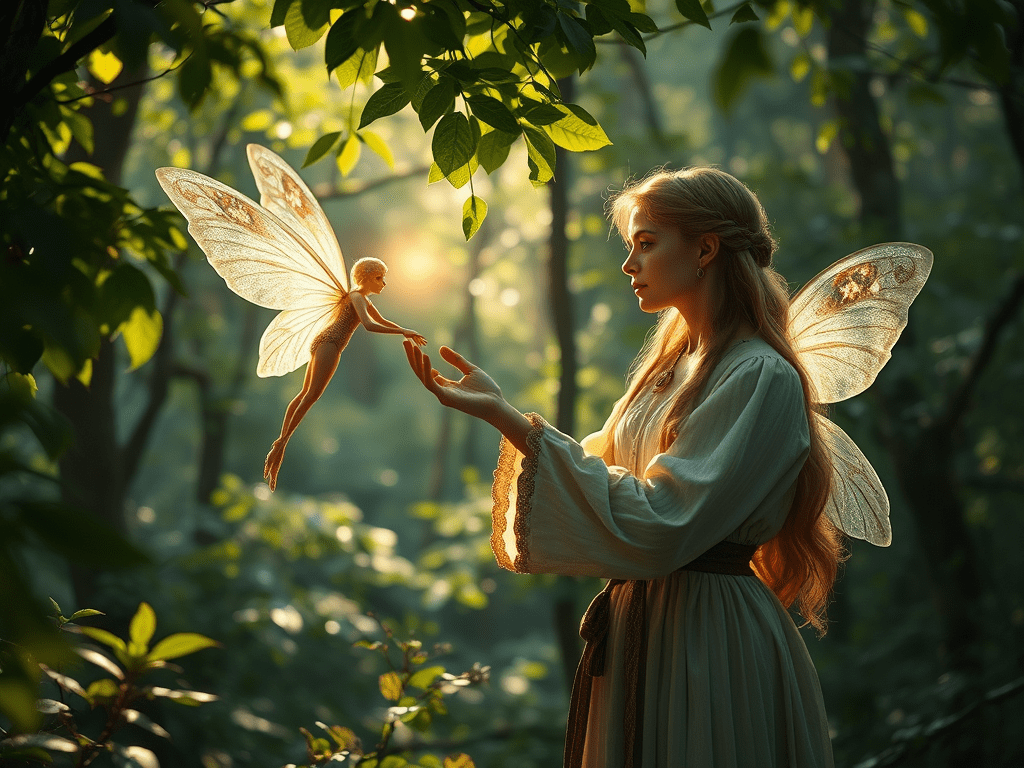
To illustrate an example in our folk memory of what’s been termed the “fairy marriage”, I am starting off this fourth chapter of The Sacred Sex Rites of Ishtar by referring to a very old poem from a time when people could still see, and still believed in, these Otherworldy inhabitants of the Hollow Hills.
It is called True Thomas and the Queen of Elfland and you can find me reciting it here on Soundcloud, set to some wonderfully enchanting music by Andreas Pirner.
This poem is so old that we don’t know who originally composed it. But it is thought to be about a real person that lived in the 13th century, a Scottish laird named Thomas the Rhymer, who, according to folklore, was granted the fairy boon of The Tongue That Cannot Lie — in other words, the gift of prophecy. He was, apparently, awarded this by the Elven Queen after his reputed seven-year sojourn with her in the land of the Fae.
But whether or not his supernatural abduction really happened, his relationship with the Fairy Queen is a clear example of the Fairy Lover and the Fairy Marriage… which doesn’t just happen in romantic fiction.
I began this chapter with some trepidation. I not only believe in fairies; I’ve an enormous amount of respect for this race of superior Elder beings which has been banished from our collective consciousness for thousands of years. I want to be sure that I explain everything as they would wish it, because they are generally far wiser and more spiritually evolved than us and, as a mere human being, it’s difficult sometimes not to write or talk about them too clumsily or too blithely, and the worst thing I could do is to damn them with faint praise.
I will be using the following few chapters to introduce you to this subject, and give you examples and illustrations of the importance of the fairy folk to the spiritual evolution of the human being.
You will also learn about the evidence for how our ancestors valued this interdimensional relationship, and behaved accordingly.
Need more like this?
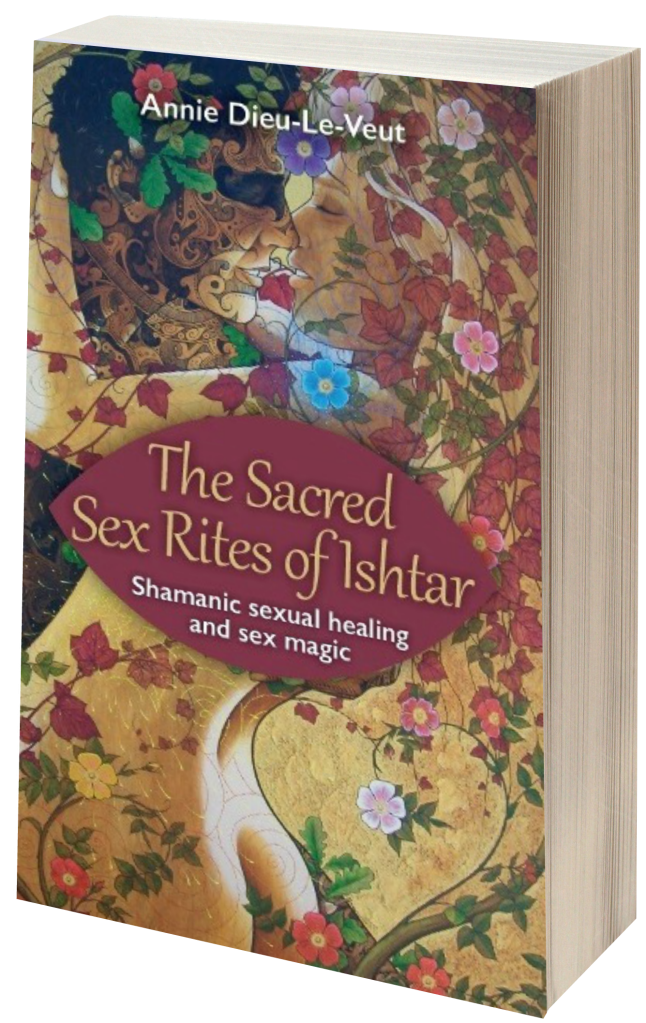
You’ve just read an article by Annie Dieu-Le-Veut, the author of The Sacred Sex Rites of Ishtar.
To get this book, just click here to be taken to where you can buy it on Amazon.
Available in paperback or for your Kindle.
So I quite understand that it might come as a surprise to some to hear that fairies really do exist and not just at the end of the garden. It was news to me, when I first realised it, many years ago… but now their presence is just a part of my normal, everyday life.
I first began to sense them around when I was a few years into my shamanic training. At first, I learned how to visit the spirits of the Upper World and Lower World.
The term for visiting these other dimensions is “journeying”. In journeying this way, I found that the spirits of the Upper World appear as human or humanoid, sometimes even angelic, while the spirits of the Lower World tend to be animals, or half-animal/half-man beings such as centaurs.
I was never actually trained to journey into the Middle World, of which this planet is a part, but I was eventually invited in by my spirit guides and trained by them to interact with the Earth spirits I found there, otherwise known to our ancestors as the Fae, and from which the word “fairy” comes.
I’ve learned …. over some time … that there used to be a very special relationship between humans and the Fae, in which they would marry each other and have offspring, in both worlds. From that, I can only surmise that there must be millions walking around on the Earth today who have fairy DNA, if they did but know it.
The Fae are also known as the Sidhe, the Gentry, the Little People and the Tuatha da Danaan, to name but a few of their sobriquets.
We have many misconceptions about the fairies, these days, and perhaps the first knot of misunderstanding that we need to unravel is over their appearance. They rarely manifest, to me anyway, like the tiny gossamer-winged Tinkerbelle of Victorian fantasies. On the contrary, some of them are huge. Some are even covered in fur. But mainly, they look very much like you and me, and if you passed one on the street when you were in a hurry, you may not even notice them.
The Fae are spirits or guardians of the land, of this Earth, and they’re not to be confused with the goddesses or angels of the Upper Worlds.
Another name for the Fae is the Elders. The old folk tales recount how they fell from the stars at a much earlier Time than we did, and thus their experience of Time is very different to ours.
According to these wisdom teachings, the Fae emerged on Earth at what is known as the First Utterance. At the Second Utterance, the animals appeared, and at the Third, we humans “fell from the stars”. I don’t think this means literally “falling from the stars”. To my understanding, this expression is all about inter-dimensional portals.
I’ve found that the archaeological record in no way supports the Darwinian hypothesis of slow and gradual evolution of smaller and smaller species from prehistoric giants. What it does show, though, is not so much evolution, but that there have been various revolutions at different times with certain species seeming to come, all of a sudden, from nowhere.
However, we’re no longer taught how to read myths in the correct way, and so “the fall from the stars” has come to be associated with sinning or being banished from the heavens, and Heaven. This concept of the “the Fall” was a much later Christian idea, which has twisted the true pagan lore out of all recognition. Whether or not this re-spinning of the yarn was done deliberately, we cannot say. But it is certainly true that this way of viewing “the Fall” allowed the Church to rewrite history to suit its own agenda and control the narrative.
Luckily, we can still find the truth in fairy tales, if we know how to interpret them. In many stories about the Three Utterances, a special entity came down when the Fae “fell from the stars”, ever since which time she has remained buried in the Earth, sleeping.
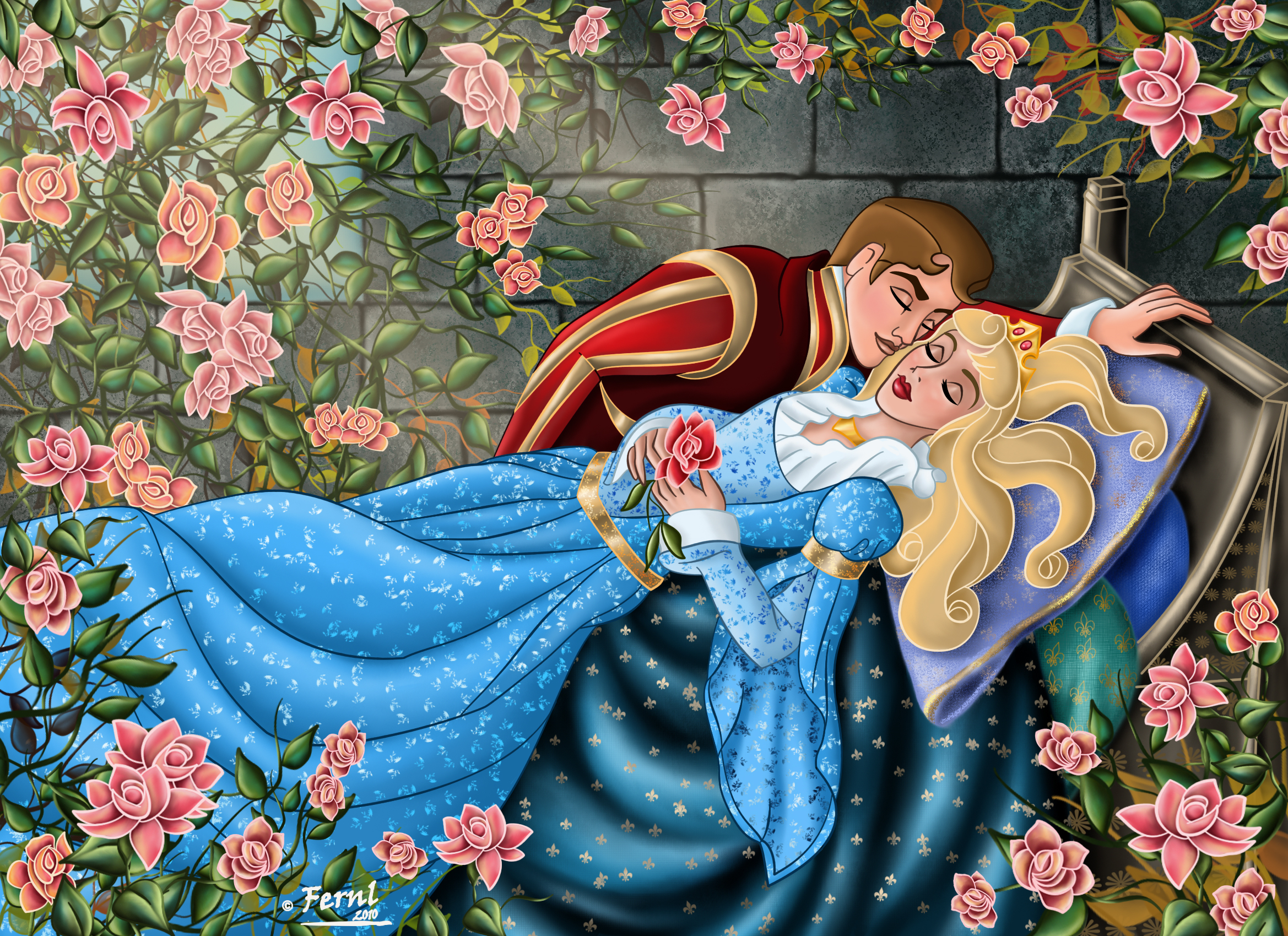
This is the central theme expressed in the story of the Sleeping Beauty, and so it’s most likely another alchemical allegory for the Faery or inter-dimensional marriage. As she sleeps, the Sleeping Beauty is protected by a briar rose thorn thicket. According to this lore, she will only awaken when the Three Utterances — man, animal and Faery — come together in Harmony and Love to create the Fourth Utterance. This is the kiss which will awaken the Sleeping Beauty, just like, in the last chapter, it was the prick of Eros’s arrow which awoke Psyche.
Meanwhile, the Land is enchanted… literally en-chanted… chanted into existence …ever since the First Utterance. There have been perpetual choirs chanting ever since the Elders first fell from the stars, singing to maintain the sacristy of the Land, from the dawn chorus of the birds to the Gregorian Litany of Hours verses sung n the enclosed monastries and nunneries.
These vibrations of sound build and maintain protective sonar walls around sacred sites, and they also purify the waters and the natural crystals in the leylines.
In Glastonbury, in Somerset, the Fae sing continually, in a sort of folksong-cum-military marching band style, about how they will “forever defend the Glassy Wall”. I know because I’ve heard them. The Celtic name for Glastonbury used to be Yns Wytrin and it means Isle of Glass.
I’ve heard the Fae singing in Scotland too, where they’re accompanied by bagpipes and fiddles. I’m convinced that the merry Scottish jigs and reels we know and love are inspired by the dancing tunes of the Scottish Fae.
I have a friend in deepest Cornwall who hears the Fae singing by running streams – he says they sound like children laughing and playing. The place where he lives is known as Hobbs Hill (Hobbs being an old name for the Fae) and he’s had many a magical encounter around those parts.
Another friend, a synesthete, hears the Fae Elementals singing the flowers open to the sun, at dawn. His sense is that they are creating the energetic template for the day and he believes the birds are doing likewise with their dawn chorus – singing the creation into existence, afresh and anew with the dew, with sacred walls of sound.
I recently saw a frequency spectograph reading — it was taken of the birds’ dawn chorus on Earth by an ornithologist, and it looked exactly like they were building cathedrals of light. (You can see it here: Cathedrals of Light.)
The author Eleanor Farjeon captured the essence of this feeling in her hymn:
Morning has broken
Like the first morning
Blackbird has spoken
Like the first bird.
Praise for the singing,
Praise for the morning
Praise for the springing
Fresh from the Word.
Need more like this?
You’ve just read an article by Annie Dieu-Le-Veut, the author of The Sacred Sex Rites of Ishtar.
To get this book, just click here to be taken to where you can buy it on Amazon.
Available in paperback or for your Kindle.
It’s my experience that the ancient Anglo-Saxon kings, going back at least as far as Alfred the Great, gained their right to rule this country of Britain from a tangible and sacred union between the royal personage and the spirits of the Land, otherwise known as the Fae.
This is the real meaning of the Sovereignty of the Land.
The name Alfred means “elf counsellor” and looking at his life, and the Druid magical rites he quite probably performed at Burrow Mump in Somerset before that last decisive Battle of Edington in 878CE, in which he routed the Vikings, I’d say that he was certainly in communion with the Fae, the spirits of the land.
It seems that the land was always jointly governed in this way and both sides – Fae and human – took their guardianship duties seriously. But of particular importance was the purification of the energies, to keep the portals clear between the liminal walls dividing the dimensions. This cleansing and healing was largely carried out by what we now call “sound healing” by the perpetual choirs. Beating the Bounds is probably the last vestige of this practice.
The perpetual choirs are first mentioned in a four-line Welsh Triad which was translated in the 18th century by George Ellis, Fellow of the Royal Society and a close friend of Sir Walter Scott:
Three Perpetual Harmonies of the Island of Britain:
One was at the Island of Afallach,
and the second at Caer Garadawg,
and the third at Bangor.
Affallach is another ancient title for Glastonbury; Caer Garadawg is thought by all to be near Salisbury, either Stonehenge, Old Sarum or Avebury; and “the third at Bangor” refers to Bangor in north Wales, near Wrexham.
The perpetual choirs of the Holy Triumvirate of Fae, Animals and Humans would continually sing in order to create sound waves to carve out and purify inter-dimensional space and form. These days, we’ve forgotten its importance to maintaining the fertility of the soil. Thus it’s now just the Fae and the animals who are faithfully keeping up the enchantment of the land – one very good reason why we need to understand the importance of returning to the covenant between Man and Faery.
Faery shaman Coleston Brown writes in his book The Sigils, Treasures of the Faery Covenant:
The Faery Covenant is an ancient binding agreement between human and faery beings that arises out of the First Light, the primordial awareness in which all beings shared at the beginning of time.
The Covenant is intimately bound up with our relations with the fairies, and hence with Nature, animals spirit beings, ancestors, each other and also with the self.
“As such, the Covenant is crucial for the fulfilment of human destiny and the fate of our planet.
In the Isles of Britain, some trace the perpetual choirs back to the choristers of the 12th and 13th centuries, when new and glistening cathedrals were built according to divine geometrical principles, reputedly by the Templars who learned their Masonic craft in Egypt.
These cathedral builders constructed what have become known as “symphonies in stone” or “frozen music”, based on the Hermetic principles of “as Above, so Below” and inspired by the understanding that the wisdom about sacred geometry, architecture and sound were all intertwined to produce certain healing and transformational harmonics.
However, we can trace the knowledge about this kind of sound healing architecture back even further – to the Age of the Giants. The Age of the Giants is known as such not because there were necessarily giants on the Earth at that time, but because we no longer understand how mere men moved the huge stones that make up the sacred megalithic temples, like Avebury and Stonehenge. So this gives the impression that they’ve been built by Gog and Magog.
In the temples of Malta and Gozo (at least a thousand years older than the pyramids), scientists are finding acoustic clues that these structures were designed to encourage the shamanic trance state with the use of sound frequencies.
Corbelled ceilings, that are mirrored in subterranean mortuary shrines, have been carved out of solid limestone at Malta’s Hal Saflieni Hypogeum, a multi-level complex of caves and ritual chambers. Voices echo and bounce around the walls and standing inside it is like being within a huge bell; you can feel the sound in your bones.

During scientific testing, the stone rooms in Malta were found to match the same pattern of resonance, which registered at the frequency of 110 or 111 hertz. This turned out to be a significant level for the human brain and thus we can conclude that the people who spent time in such an environment were exposing themselves to vibrations which sent them into trance-like states.
Sound scientist Professor Daniel Talma, of the University of Malta, said:
At certain frequencies, you have standing waves that emphasise each other and other waves that de-emphasise each other. The idea that it was used thousands of years ago to create a certain trance — that’s what fascinates me.
It also looks as if a 7,500-year-old megalithic site in the mountains of Armenia was set up in order to optimise its auditory qualities. It is known as Carahunge; in Armenia “Car” means “stone” and “hunge” means “voice” or “sound”.
Certain geometrical arrangements help to produce certain resonances.
Some researchers have found that key stones at Avebury, in Wiltshire, are laid out in a Pythagorean triangle representing the numbers 3, 4 and 5, while at Stonehenge they’ve found a hexagonal star within a square.
Some, in the Neolithic Age, chose stones with special properties to be part of their monuments. They often used stones with crystal content, placing them over where streams crossed underground.
There are stones, or menhirs, which “sing” at a site on the River Aksai in Russia, which is much older than Stonehenge. It dates to 9,000BC and the stones are made from quartz.
It’s interesting that the electromagnetic radiation that causes the stones to sing there is more intense on the Spring and Autumn Equinoxes, just when we know that these Neolithic festivals took place, the times when shamans tell us that the liminal walls between dimensions are thinner.
I must also include, in this round-up, the wonderful singing stones at Padang in Malaysia. On the first terrace, there is a group of stones called the gamelan or singing stones, because when struck they produce melodic notes – of F, G, D and A.
And so it goes on… every now and then, a further site of standing stones or another ancient temple gives up its sound secrets, so that we’re now beginning to understand again the importance of sound and enchantment to our ancestors, as a magical key to open the locks of inter-dimensional or faery portals.
It seems to me that we have to resort to shamans to unlock some of this knowledge. While archaeologists are getting much better at recognising ritual sites and the geometries and astronomical alignments of ancient sacred architecture, they don’t have the tools to figure out why our ancestors found it so important, and who they learned it all from.
So we’re just left with vague and wistful memories that sometimes stirs within us, or disturbs our dreams, although we rarely have words for it now and so we have to rely on poets, musicians and painters to express it for us.
These artworks inspire us, and we find ourselves longing for the order and harmony within our tribes and villages of those days, where there was cohesion and continuity that stemmed from the laws that emanated from true wisdom.
Need more like this?
You’ve just read an article by Annie Dieu-Le-Veut, the author of The Sacred Sex Rites of Ishtar.
To get this book, just click here to be taken to where you can buy it on Amazon.
Available in paperback or for your Kindle.
According to the late geomancer John Michel, in his book Twelve-Tribe Nations, on high days and holy days, such as solstices and equinoxes, the ancient tribes of Britain would come together at certain locations and their kings or leaders would each hit their own stone to sound their note of what was a 12-part harmonic that enchanted land. From that vibration, which reflected the sacred geometry of the Above down to the Below, harmony and order were maintained across the Land.
As we’ll go on to discuss in further chapters, the boons of Venus/the Faery Queen are beauty, harmony, order and proportion. But today, and in the absence of a sacred relationship between Man, Fae and Animals, there’s much less harmony and order in the music being produced commercially. Instead, quite often, we find ourselves feeling alienation, discord, disharmony and chaos in what we listen to. This has duly led to the arrival of the Four Horsemen of the Apocalypse: death, famine, disease and war.
Some believe that the music industry is deliberately promoting disorder and disharmony on behalf of the globalist players, whose modus operandi is to bring order out of that chaos, to create a new world order. But whether it’s deliberate or not, we are reaping the whirlwind, in so many ways… and not least in terms of our health and wellbeing.
After reading this chapter, you should have a clearer idea about the Fairy race and their role with us and the animals; and also about how our ancestors worked with them to maintain harmony and order, via enchantment, which brought real Sovereignty and faery power to the kings and queens reigning the lands.
I look forward to teaching you more about the Faery or Divine Marriage, and how the occult secrets about it are buried deep within our greatest literature, in the next chapter.
Need more like this?
You’ve just read an article by Annie Dieu-Le-Veut, the author of The Sacred Sex Rites of Ishtar.
To get this book, just click here to be taken to where you can buy it on Amazon.
Available in paperback or for your Kindle.


 Annie Dieu-Le-Veut
Comments