
If you’re at all interested in the star magic symbolism of Beltane, and why we celebrate it here, on the Summerlands of Avalon, by processing behind the drummers escorting the red and white dragons up to the Fairfields of Glastonbury Tor, then the following article is for you. It unravels the deeper meanings for why the dragons are red and white, and what they represent, and who the May Queen really is, and just why Beltane is such a magical time of the year, so please do read on:
The word Beltane is the anglicised form of the Old Irish Beltain and Scottish Gaelic Bealltainn, and it is thought to be derived from the belo-te(p)niâ, meaning “bright fire”, or “bale fire”, which means “white and shining”.
It falls on what’s known as a Celtic quarter day. Some have tried to link these old Celtic quarter days to the midpoint between the equinoxes and the solstices, but actually that doesn’t work astronomically, because Beltane would then need to be on 5th May.
In fact, the timing of Beltane comes from a much older strata of astronomical lore than that of the solar priesthood who built Stonehenge. It comes from those whose calendars were lunar rather than solar, and whose lives were dictated by stellar and planetary movements, and these people are the ancestors of the Irish and the Welsh that we call the Celts.
Beltane originally was connected with the time when the white and shining constellation of the Pleiades begins to set below the horizon. It’s sister fire festival is held on the last day of October, which is now known as Halloween, but to the Celts, it was the festival of Samhain, which takes place when the Pleiades begin to rise again.

In Ireland, and increasingly now in Scotland, these great stellar fire festivals are being revived. This photo shows the illustrious and upstanding members of the Beltane Fire Society celebrating on Calton Hill in Edinburgh, Scotland.
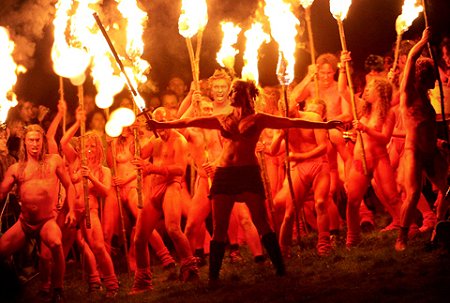
The good folk of Edinburgh are reviving a custom of the ancient First Peoples to settle these Isles, who believed that fire had a purificatory function, and protected you from malign influences. Even today, this is understood by magicians, alchemists and shamans alike.
For it is said that Beltane is also a threshold or portal time. This is when the liminal walls between the dimensions are at their thinnest and we are more likely to encounter the Fae, otherwise known as the Tuatha de Danann, the Sidhe (pronounced shay) or the one I prefer, the Gentry.
Some people call them fairies, but according to those that have seen them, they’re actually not the least like sweet little Tinkerbell. The tiny delicate winged flower fairy in gossamer dress was a Victorian confection which took its inspiration from Christian angels, but has no grounding in ancient lore. R J Stewart in his book The Living World of Faery says that some of the Fae are really enormous, like giants. Others are the same size as us. The ones that I get to meet look just like me… and they don’t have wings.
They are the spirits of the Land; they maintain the fertility of the Land, which to them, is sacred, and it is from these beings that the Sovereignty comes. They inhabit a parallel dimension which is known in mythological lore as the Underworld or the Land of the Ever Young – which J M Barrie, the author of Peter Pan, turned into the Never Never Land. He got the name Peter Pan from the ancient Greek version of the King of the Faeries, the great god Pan — rumours of whose death, it now turns out, were grossly exaggerated.
The Queen of the May

The character of the Queen of the May, who stars in carnivals and fairs up and down the land during these festivities, is derived from a beautiful woman who is still found today in Welsh myths, named Bridie or Brigit. Her brother is Gwyn ap Nudd, the Lord of the Underworld and the King of the Faeries, and so as her protector, he has to fight a duel each Beltane over her honour with the Lord of Summer, Gwythyr ap Greidawl.
While the Brigit the Bright One’s time is Imbolc in February, when the snowdrops and crocuses are just beginning to be born into the light, the season of the saturnine Gwyn ap Nudd is the Plutonic dark of winter, over which he wins rulership by means of a duel with the Lord of Summer in October at Samhain at the end of October.
The two faery lords, Gwyn and Gwythyr, represent the constellations of Orion and Ophiuchus. Between them they govern the whole Wheel of the year, but each has to give way to the other as it turns from winter to summer and so on. So Gwyn and Gwythyr have to fight this duel at Beltane at the beginning of May and again, at Samhain at the end of October.
In ruling the months of the lower half of the zodiac, Gwyn is the psychopomp whose role it is to guide the initiate down into the Underworld for the Judgement as much as the Egyptian Anubis performs that function in the Papyrus Texts and the Sumerian Nabu ferries Gilgamesh along a river into the Realms of the Dead. The Arthurian scribes of the Norman conquest personified that psychopomp character as Morgan of the Fae who takes the wounded Arthur in her boat through the mists of Avalon into the Otherworlds.

The mythological psychopomp symbolises Mercury, who was known to the ancient Greeks as Hermes, the so-called ‘trickster god’ who conducts souls into the afterlife – hence why the term Hermetic Arts is often used for the practice of alchemy. The metal quicksilver, which is governed by Mercury-Hermes, can be quite tricky to work with!
Trickster gods, like Puck in Shakespeare’s A Midsummer Night’s Dream, are always representatives of Mercury, who is the catalyst of all alchemical processes but particularly that of the Marriage of the Sun and the Moon. No matter the amount of painstaking effort put into an operation, without Mercury’s divine intervention, the Child of the Philosopher will be stillborn.
The Marriage of the Sun and the Moon is represented in the Summerlands at Beltane by the drummed procession of red and white dragons, whose alchemical melding produces the birth of the Philosopher’s Child, which is what Beltane is ultimately about. It is the Alchemical Marriage, or the Fairy Marriage which takes place between the Lord of Summer and the Queen of the May under a Scorpio full moon.
If you would like to read more about their romantic tryst, as it’s depicted in the night skies over Avalon at Beltane, please read The Honey Moon of the Gods.
Featured picture credit: SWINS COM


 Annie Dieu-Le-Veut
One response to “Beltane, May Day and the story written in the stars that fall on the Summerlands”
[…] via Beltane, May Day and the story written in the stars that fall on the Summerlands — Annie Dieu-Le-V… […]
LikeLike